
marketing

How to Get Home Care Clients

Three options determine whether a home care agency gets clients or not: referrals, online presence, and response speed. Most operators work two and ignore the third. This guide covers how to build all three into a system that brings in new clients consistently.

KEY TAKEAWAYS

  • Medicare and Medicaid clients come from clinical referrals and relationships- hospitals, physicians, discharge planners
  • Private pay clients find you online - Google Business Profile, your website, targeted ads
  • Speed wins: a 5-minute inquiry response is 9x more likely to convert into a client than a slow one
Claud LogoAsk Claude to summarize
ChatGPT LogoAsk ChatGPT to summarize

The 3 ways to get home care clients:

1. Referrals from businesses and past clients

The fastest path to consistently getting home care clients. Hospitals, physicians, attorneys, and happy families send you clients when they trust you. Building and protecting those relationships is the foundation of every successful home care agency.

2. Your online presence

Families search before they call. Your Google Business Profile, your website, and your reviews are making a first impression before you ever pick up the phone. A weak online presence means clients go cold and searches go to a competitor.

3. Your ability to respond fast

This one kills more agencies than bad marketing does. Home care decisions happen in hours, not days. A family in crisis who calls three agencies and hits a voicemail at two of them signs with the third. Being reachable, responsive, and quick to follow up isn’t a customer service issue. It’s a growth issue.

Most operators who struggle to get home care clients are focused on option one or two while ignoring the third entirely. All three work together to get you home care clients.

First: Know Who You’re Marketing To

You’re not always marketing to the client. Many times, you’re marketing to their family.

Most often it’s a woman in her late 40s to early 60s balancing a career, her own kids, and a parent who suddenly needs help. She’s not browsing casually. She’s in problem-solving mode under real time pressure. A hospital sent a discharge notice. She has 24 hours to figure out what comes next.

The agency that shows up first in search results, in a referral recommendation, in an ad wins the client. Your marketing has to be running before the crisis hits, not launched after it does.

Private Pay vs. Medicaid Waiver: Two Different Client Sources

How you get home care clients depends entirely on who is paying for the care. Private pay and Medicaid waiver clients don’t find you the same way. Marketing both identically is one of the most common and costly mistakes operators make.

Metric
Private Pay
Medicaid Waiver
Decision Maker
The Family (Adult Daughter)
The State or Case Manager
Primary Channel
Google Search, Reviews, Word of Mouth
B2B Relationships, State Program Enrollment
Decision Timeline
High Urgency: 24 to 72 Hours
Bureaucratic: Weeks to Months
Marketing Approach
Digital-First: Authority & Speed
Relationship-First: Compliance & Volume

Private pay families search. They google “home care in (city)” at 11pm from a hospital waiting room. Your online presence, your reviews, and how fast you answer the phone determine whether they call you or the agency below you in the results.

Medicaid waiver clients come through the system. State-managed programs, county case managers, and referral relationships control access. Digital marketing has almost no impact here. Relationships do.

Option 1: Build a Referral Engine

Referrals are the fastest and cheapest ways to getting home care clients consistently. Most agencies get their first clients this way and their best clients come through this channel for years.

1.1 Professional Referral Gatekeepers

A referral gatekeeper is a professional who comes into contact with your potential client before you do and has the ability to send business your way. When a patient leaves the hospital and is told they need home care, the discharge planner decides who gets that call. That’s the referral gatekeeper.

There are four categories worth building relationships with. They’re not equal in urgency.

Tier 1: Acute and Post-Acute Clinical Partners Highest volume. Fastest converting.

  • Hospital discharge planners want to clear beds safely and quickly. Home care is their solution.
  • Clinical social workers manage the emotional and logistical handoff to the family.
  • SNFs and rehab centers are moving patients from 24/7 clinical care back to home and need step-down support.
  • Medicare home health agencies are a natural partner. When skilled hours end, private duty hours begin.
  • Hospice providers need supplemental personal care for families during end-of-life stages.

Tier 2: Physician and Diagnostic Partners High trust. Long-term relationship.

  • Primary care physicians and geriatricians are the most trusted voice for a senior.
  • Neurologists specializing in Alzheimer’s, dementia, and Parkinson’s are a direct pipeline for long-term care clients.
  • Orthopedic surgeons generate significant short-term care after hip and knee replacements.
  • Cardiologists managing CHF patients at home are trying to prevent readmission. Your agency helps them hit that metric.
  • Independent pharmacists who see medication non-compliance firsthand are an underused source most agencies never contact.

Tier 3: Legal and Financial Partners Private pay pipeline.

  • Elder law attorneys refer when families are setting up trusts or qualifying for Medicaid.
  • Estate and financial planners help families budget for long-term care costs.
  • Long-term care insurance brokers refer clients who already have funding in place.
  • Fiduciaries and professional guardians make care decisions on behalf of seniors and need a reliable agency they trust.

Tier 4: Community and Residential Partners Early warning. Chronically underused.

  • Independent and assisted living facilities that don’t offer one-on-one care refer out to keep residents in their apartments longer.
  • Senior centers and adult day programs notice when a regular member is becoming more frail.
  • Veterans Service Officers help veterans access Aid and Attendance benefits for home care.
  • Area Agencies on Aging manage waitlists for subsidized care and are a free referral pipeline most operators never tap.
  • Faith communities. Clergy who visit homebound members are often the first outside contact a family reaches.

The Referral Matrix

Tier
Gatekeeper
Your Value Proposition
Tier 1
Discharge Planners
We prevent readmissions and can start care within 24 hours.
Tier 2
Elder Law Attorneys
We keep seniors out of facilities and preserve family assets.
Tier 3
Home Health Agencies
We cover the private duty hours Medicare doesn’t.
Tier 4
LTC Insurance Brokers
We handle the ADL documentation their clients need for claims.

How Do You Get Referral Gatekeepers to Send You Business

Option 1: Direct Outreach

Pick up the phone or walk in the door. You’ll hear no more than yes, at least at first.

When you get in front of someone, keep it simple. Tell them your agency is dependable, that you respond fast, that you have coverage in their area, and that you can handle the types of clients they work with. You’re not pitching features. You’re establishing yourself as a reliable option when they need one.

Speed and reliability are what get you remembered. Not brochures.

Option 2: Warm Outreach Through Events

Educational lunch-and-learns work well for operators who are better at relationship conversations than cold calls. The key is where you host and who you bring with you.

Don’t host at your office. Host at the senior center, the local VFW hall, or a community room at the library. Co-present with someone who adds independent credibility: a physical therapist presenting on fall prevention at home, or a geriatric care manager walking through when it’s time to consider home care.

When you bring in an outside expert, you’re not selling. You’re curating. That’s a completely different dynamic with the family member in the room who came for information, not a pitch.

Topics that work:

  • “Home Safety and Fall Prevention After a Hospital Discharge”
  • “When Is It Time? Navigating the Transition to Home Care”
  • “How to Access VA Aid and Attendance Benefits for Home Care”

Your goal is to be the consultant in the room, not the vendor.

Do both. Direct outreach and events aren’t either/or. If you want to get home care clients fast, run both plays at the same time.

1.2 Turning Past Clients Into a Referral Source

Word of mouth is a channel that most operators leave almost entirely to chance. A happy client and their family are one of the most powerful referral sources you have. They just need a reason to act on it.

Ask directly. When a client is thriving and the family is relieved, ask them if they know anyone who might need help. Most will say yes if you give them a reason to think about it. It doesn’t need to be more complicated than that.

Create vocal advocates. Exceptional service is the foundation but it’s not enough on its own. Follow up with families after the first 30 days. Check in when you don’t have to. Send a card. These small actions turn a satisfied client into someone who tells everybody they know.

Get it on video. A 60-second video from a family member describing what your agency did for them during a hard time does more work than any marketing copy you’ll ever write. It’s your most powerful credibility asset and it costs almost nothing to produce.

1.3 Protecting and Managing Your Referral Network

Track every source from day one.

A spreadsheet works. Your scheduling software likely has a source field. You’re looking for which gatekeepers are actually converting and which ones you’re spending time on without a return. Over time this data tells you exactly where to focus.

Protect the relationships you have.

Follow up every time a gatekeeper sends you a client. Thank them. Take them to lunch. If your referral source knows you’ll never drop the ball or make them look bad, that trust compounds.

One gatekeeper who changes jobs three times over five years can open multiple referral streams or hand them all to your competitor if you go quiet. These relationships are business assets. Treat them like it.

Don’t put all your eggs in one basket.

Most operators rely on one or two referral sources and call it a referral strategy. If 80% of your clients come from one hospital and the discharge planner leaves, your census follows them out the door. Diversify across tiers before you need to.

We do home care marketing.

SEO, online advertising, websites - your entire online presence. We build and run marketing strategies that works, so you can focus on care.

See how we work

Option 2: Build an Online Presence That Works While You Sleep

Getting home care clients through digital and online channels requires three things working together: a complete Google Business Profile, a website built for local search, and paid advertising when you’re ready to scale. None of them work as well alone as they do together.

2.1 Google Business Profile

The single highest-ROI free action you can take to get home care clients is building out your Google Business Profile completely.

Your profile is what families see before they ever reach your website. A complete, active profile with strong reviews will bring in more home care clients than most paid advertising campaigns.

What to prioritize:

  • Fill out every field. Services, description, hours, photos, coverage area. All of it.
  • Get reviews. Ask clients and families at the 30-day mark when satisfaction is highest. Respond to every single one. Google treats engagement as a signal that your business is active and rewards it with higher placement.
  • Use a real address. A verified office address outperforms a service area listing in local results. If you’re just starting out without an office yet, a virtual mailbox is a low-cost fix.

Also claim Bing Places, Care.com, Caring.com, and A Place for Mom. Fill them out once and move on. They support your overall credibility but they’re not where your attention should live.

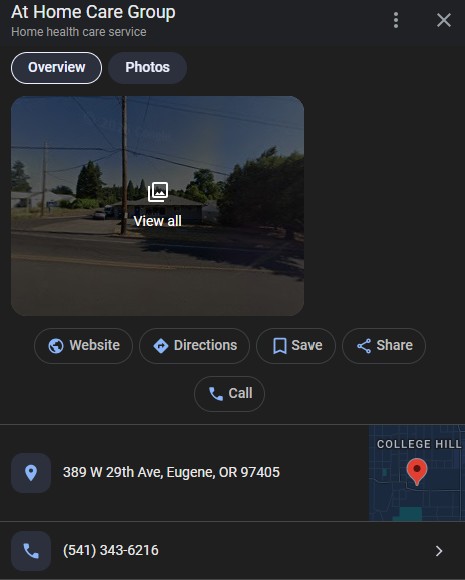
Good Example:

home care google my business profile
  • Lots of reviews
  • Services filled out
  • HQ address
  • Dense profile with images

Bad Example:

thin google my business profile
  • Zero reviews
  • No services listed
  • Using residential address for business address
  • Missing opportunity to fill-out the profile with photos

2.2 A Non-Marketer’s Guide to Getting Found on Google

Your website is a 24/7 salesperson. Most home care websites are terrible ones.

The bar is genuinely low in this industry. A well-built site can outrank agencies that have been operating for years because most of them haven’t invested in theirs.

Here’s how Google actually works:

Google doesn’t watch your business. It reads it. If your website is a single page, Google assumes your business is small and limited. More specific pages covering more specific areas tell Google you’re a real, established local operator.

The location-service page strategy:

If you serve 5 towns, you need 5 pages. Each page follows this formula:

[Service] in [City]

  • Home Care in Naperville
  • Memory Care Support in Evanston
  • Post-Surgical Home Care in Oak Park

Don’t copy and paste the same content across pages. Mention the local hospital you serve, the senior centers in that specific town, the neighborhoods you cover. This tells Google you’re not a national chain. You’re the local expert.

A well-built home care website needs:

  • A homepage that’s clear about what you do and where
  • An about page that feels human and specific, not corporate
  • A contact page with a phone number that’s impossible to miss
  • Location pages for every city, suburb, and area you serve

2.3 Paid Advertising: When You’re Ready to Scale

Don’t run ads until your Google Business Profile and website are solid. You’ll burn the money.

When you’re ready, here’s what actually works for getting home care clients through paid advertising channels.

What Works

Google Search Ads are best for immediate census fill. Someone searching “home care near me” has intent. Showing up at the top of that result with a clear offer converts. The tradeoff is cost and ongoing management time.

Meta ads on Facebook and Instagram reach people who aren’t actively searching. They work best for awareness and retargeting visitors who didn’t call. Meta is also your most effective channel for caregiver recruiting, which matters because advertising for clients you can’t staff damages referral relationships fast.

What Doesn’t Work

Billboards. Radio. Local TV. Shared leads from aggregator platforms. You’re not trying to reach everyone in a city, you’re trying to reach one specific person at one specific moment. Broad channels waste most of your spend. Shared leads put you in a price war before the first phone call.

You’re not Coca-Cola. You’re "home care services near me".

The Math Before You Spend Anything

Most non-medical home care runs between $32 and $42 per hour depending on your market. Most agencies require a minimum of 20 hours per week. Here’s what that means for client value.

Customer Lifetime Value

Metric
Part-Time (20 hrs/wk)
Full-Time (40 hrs/wk)
Hours per week
20
40
Rate at $35/hr
$700 / week
$1,400 / week
Monthly revenue
~$2,800
~$5,600
6-month lifetime value
~$16,800
~$33,600

When you understand that one client is worth $16,000 to $33,000 over their time with you, spending $800 to acquire them through Google Ads isn’t a cost. It’s an investment with a return most businesses never see.

Industry benchmark: $400 to $800 cost per private pay client acquisition depending on your market.

Know your average client value before you spend a dollar on ads.

DIY vs. hiring:

More time than money, under 5 clients: Start with Google Search Ads and manage them yourself.

Ready to spend more than $1,000 per month: Hire a professional. Here’s the real reason why.

A DIY advertiser tells Google: “Find me anyone who clicks home care.” You get job seekers, people looking for free government programs, and families three years away from needing anything.

A professional tells Google: “Find me people like this client who just signed a $5,600 contract.” By connecting your CRM data back to the ad platform, the system learns to ignore the tire-kickers and focus spend on the families who actually hire. That feedback loop is what makes advertising efficient at scale.

Thousands of buyers are actively looking for a home care business like yours right now.

We make the introduction — no public listing, no disruption to your staff or clients.

Connect with buyers

Option 3: Be the Agency That Actually Responds

The first agency to respond wins the client the majority of the time.

Research shows responding to a lead within 5 minutes has a 9x higher opportunity to convert than responding 30-minutes later.

This is the option most operators never think of as marketing. It is.

Getting home care clients through referrals and digital channels means nothing if the experience of contacting your agency is slow, cold, or inconsistent. Responsiveness is where growth either accelerates or stalls.

3.1 Why Responsiveness Is a Growth Strategy

Home care decisions don’t happen on a comfortable timeline. A family gets a discharge notice. A parent falls. A doctor recommends additional support. The window between “we need help” and “we picked an agency” is often 24 hours or less.

The first agency to respond wins the client the majority of the time.

Speed to Lead

Responding to an inquiry within 5 minutes produces a conversion rate 9x higher than waiting just 30 minutes. By the time most agencies call back, the decision has already been made.

That’s not a marketing opinion. It’s the reality of how families make decisions under stress. They call whoever they can reach. They go with whoever makes them feel taken care of first. If you’re the third callback at 9am the next day, you’ve already lost.

Missing a call during a family crisis isn’t a missed voicemail. It’s a lost client and potentially a lost referral relationship if a gatekeeper sent that family your way.

3.2 What Responsiveness Actually Looks Like

Phone calls: Answered live whenever possible. If you can’t answer, called back within minutes, not hours. A voicemail that sits until the next morning is a client who signed somewhere else.

Website forms and online inquiries: Same-day response is the minimum. Ideally within the hour. A family who fills out a contact form at 2pm and hears back at 10am the next day has already called two other agencies.

Email: Treat it with the same urgency as a phone call. Home care inquiries aren’t newsletters. They’re people in the middle of a crisis trying to figure out their next step.

After hours: An answering service or on-call protocol isn’t optional at scale. Families don’t only need home care between 9 and 5. The agency that picks up at 8pm on a Friday gets the client who couldn’t wait until Monday.

3.3 The Intake Call Is the Close

Most operators think of the intake call as information gathering. It’s not. It’s the moment a stressed family decides whether they trust you with their parent.

A good intake call does three things:

Makes the family feel heard. Let them explain the situation before you start asking questions. They’ve been managing a crisis. They need to say it out loud before they can absorb information.

Answers the urgent questions clearly. How quickly can you start? What does it cost? What happens next? These questions are always on their mind. Answer them without being asked.

Gives them a clear next step. Don’t end the call with “we’ll be in touch.” Tell them exactly what happens next and when. Families in crisis need someone to take the wheel. Be that agency.

The agency that feels calm, prepared, and human during a family crisis earns the trust before care ever starts. That’s how you get home care clients who stay, refer, and become vocal advocates for your business.

Pro tip: log the "Emotional Primary Concern" in your customer software (CRM) as notes. So you can always reference this in conversations.

What Most Operators Get Wrong

What Most Operators Get Wrong

Focusing on one options and ignoring the others. Spreading too thin before mastering one channel. Making one introduction and disappearing. Buying shared leads. Advertising for clients you can’t staff. Not answering the phone.

  • Focusing on one options and ignoring the others. Referrals dry up without an online presence to back them up. A great website with no referral network sits empty. Fast response times don’t matter if no one can find you. All three options have to work.
  • Spreading too thin across channels before mastering one. Pick referrals and your Google Business Profile first. Master those before anything else.
  • Making one introduction and disappearing. Referral relationships require consistent, low-pressure presence over time. Showing up once doesn’t build a referral stream. Never dropping the ball does.
  • Buying shared leads. Aggregator platforms sell the same lead to five agencies at once. A price war starts before the first call. Conversion rates are low and the clients who come through this channel are the hardest to retain.
  • Advertising for clients you can’t staff. If you’re short on caregivers, new clients create problems, not revenue. Solve the staffing side before you accelerate intake.
  • Not answering the phone. The first agency to pick up wins. A voicemail during a family crisis is a lost client.

Share this article

Table of contents

Grow or sell your home care agency

We help post-acute care operators get more clients through search, content, and paid media.

Get a free consultation

More Home Care articles

marketing

Home Care Advertising: Here's What Works

A complete guide to home care advertising for operators. Learn which advertising options actually convert, what to budget, and how to measure ROI before spending another dollar on ads.

Read article →

marketing

How to Get Home Care Clients

Three options determine whether a home care agency gets clients or not: referrals, online presence, and response speed. Most operators work two and ignore the third. This guide covers how to build all three into a system that brings in new clients consistently.

Read article →